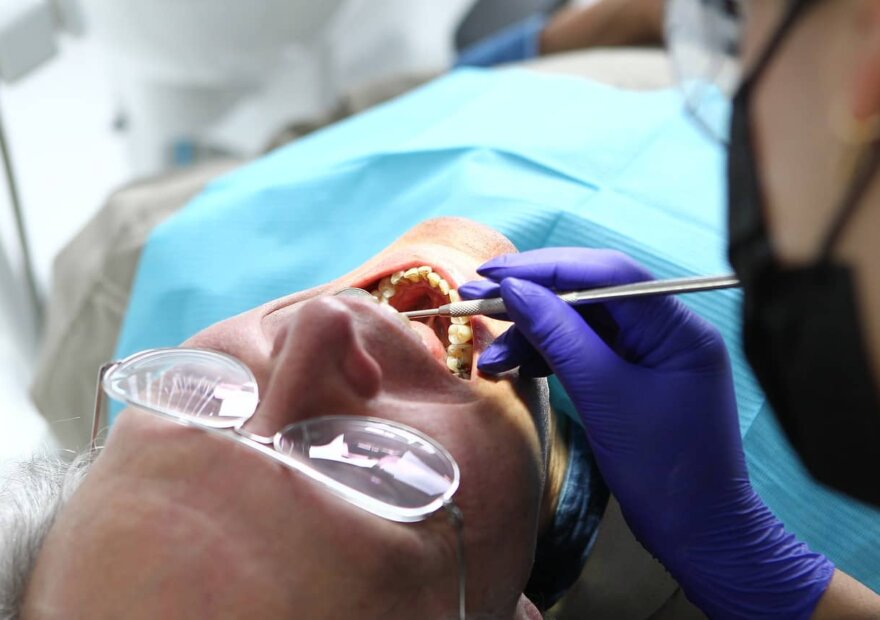

Invisalign Attachments: All Your Doubts Resolved
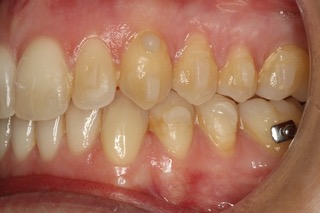
Invisalign attachments are accessories that are stuck onto the surfaces of the teeth to help move them along with the clear aligners. Their cementing is essential for the treatment to be as effective as possible and for the dental aligners to be able to move the teeth as your dentist has planned in the ClinCheck.
What are attachments like?
Attachments usually measure 1 to 3 millimetres and can be of various shapes, rounded, elongated, etc. depending on the type of movement you want to achieve.
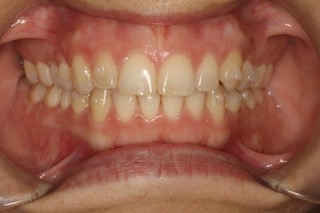
Types of dental attachments:
- Extrusion attachments: to bring the tooth down.
- Intrusion attachments: to move it up
- Rotation attachments: to turn it to the sides.
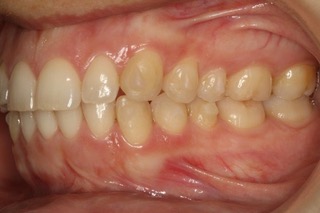
Do the attachments turn yellow?
They’re made of the same material we use to make fillings, so we can modify the colour and adapt them to the colour of the patient’s tooth.
Over time the colour can become modified and we’ll be able to replace them in the event that they get stained or damaged, sticking them again so that they’re as disguised as possible.
How many Invisalign attachments will I have?
When a patient wants to be treated with the clear Invisalign appliance they often ask us how many attachments they’re going to have and on which teeth, since they don’t want to wear braces and therefore don’t want to have attachments on the front teeth.
Until records are taken of the patient (whether with an intraoral scanner or impressions) and they’re sent to the Invisalign centre to do the ClinCheck and we receive the result, we can’t give an answer to that question.
What is the ClinCheck?
The ClinCheck is a 3-dimensional video where it’s explained to the patient how their teeth are going to look after the treatment with Invisalign, and with this video we can already see what types of attachments and on which teeth they’ll be located. The Invisalign technicians, using a computer program, place the attachments on each tooth depending on the movement it needs, that is, if a tooth is very rotated it will be necessary to place an attachment to help it rotate properly.
As we mentioned above, if the patient didn’t want, for example, to have an attachment on a front tooth, we could remove it, but the movement wouldn’t be as effective.
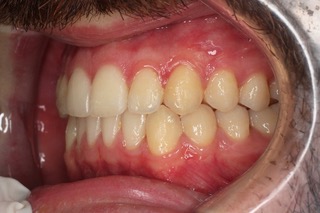
How are they stuck on?
The placement is done by sticking the attachments to the teeth in the same way as fillings, but without having to make any retention in the tooth, so it isn’t necessary to apply anaesthetic as it isn’t painful.
With the patient’s aligners we receive some softer templates with the imprints of their attachments, which we’ll fill with composite (filling material) and place over the teeth and harden them with light. Once cemented, the template is removed and the excess material around it is removed, leaving some practically invisible attachments on our teeth.
Do they cause pain?
It’s another frequent question, whether the Invisalign attachments cause pain. The answer is: No! They don’t hurt. Once cemented we’ll notice with the lips or the tongue a bump on the tooth that will be imperceptible to the people you talk to, in addition to being able to clean the teeth that have them in the same way as if you had nothing in your mouth. During the first few hours of wearing the invisible dental aligners you may notice pressure on the tooth that has them, which is why we always advise placing the new aligners before going to sleep so that we spend a few hours without taking the aligner out of the mouth, so that the teeth adapt to the new aligner.
Can they fall off?
Attachments can fall off, but it’s uncommon, unlike braces. The attachments are cemented on the outer face of the tooth and are cemented (as we’d already indicated) in the same way as a filling, but without damaging the surface of the tooth, so the adhesion is less than that of a filling. The most frequent way for an attachment to come off is from chewing itself, from the force when placing the aligners or from poor adhesion.
In the event that they fall off we should go to the clinic so that they stick them back on, so that the effectiveness of movement in those teeth doesn’t decrease and therefore our invisible orthodontic treatment gets longer.
When are the Invisalign attachments removed?
Once we’ve finished our treatment with clear Invisalign aligners it will be time to remove the attachments; for this we use rotary instruments, leaving the surface of the tooth the same as before wearing them, being a totally painless procedure that doesn’t need anaesthetic.
Once the attachments are removed, they’ll be able to make us the maintenance or retention appliances that we’ll use to sleep, without the imprints of the attachments.
In addition to the attachments, am I going to have anything else cemented to my teeth?
Another accessory we frequently use in the treatment with Invisalign aligners are the buttons. The buttons are a round accessory that can be metal or white and that’s cemented to the teeth where we’re going to use intermaxillary elastics. The intermaxillary elastics are little bands that are frequently hooked from the upper part to the lower part to be able to improve the meshing between the maxilla and the mandible, which we’ll have to learn to put on and take off and wear for the hours our dentist recommends.
The buttons are cemented in the same way as the attachments and they can also fall off, since the little bands exert force on them, so that, in the event that it happened, we’d have to go to the clinic to stick them back on.
From the Clínica Dental Doctores Tarazona we hope to have resolved your doubts about the attachments, but if you have any more doubts or want more information about the treatment with Invisalign orthodontics don’t hesitate to contact us and we’ll answer them as soon as possible.