Dental Stripping in Orthodontics: Everything You Need to Know
In this post we bring you all the information you need about dental stripping in orthodontics so that you know what this common procedure consists of, which our orthodontist uses when orthodontic treatments require it.
What is dental stripping used for in the teeth? Dental stripping or IPR has several different functions in orthodontics. Among the ones that stand out:
- Widening of the dental arches: when the patients who come for an orthodontic treatment don’t have enough space because the teeth are bigger than the bone they have, we have to gain space somehow. A common way of gaining more space in our jaws so that the teeth can align is to do dental stripping, carrying out a filing of the teeth that leaves us a gap between the teeth that we’ll use to align them.
- Stripping in the protrusion of the incisors: Do you know what it is? But dental stripping isn’t only done when we have crowding of the teeth, but also in other cases such as, for example, when we have protruded incisors, that is, ones facing forward. In this case, to be able to move the incisors back, a possible solution would be to file the teeth so that they can be retracted.
- Avoiding the extraction of teeth. Dental stripping or IPR allows us to reduce the size of the teeth, giving us more space in our jaws. In many patients, by filing the teeth we manage to avoid the extraction of teeth, which is what used to be done in the past. Nowadays, we’ll only do tooth extractions in specific cases such as, for example, when the maxilla and the mandible don’t fit together perfectly or if we have a great lack of space.
When does your dentist do stripping on the teeth?
Dental stripping or IPR is carried out during orthodontic treatments. When? It will depend on the type of appliance we wear in the mouth. In the case of wearing aligners, our orthodontics specialist will have planned, through the ClinCheck (Invisalign) or the Approver (Spark), in which aligner we have to file the teeth so that we can do the IPR properly when the teeth are in a position in which we can’t damage them. However, with patients with fixed appliances we can do the dental IPR progressively throughout the treatment when our doctor advises it, to optimise our orthodontic treatment and make it as quick and effective as possible.
This may interest you > Healthy gums: Importance before starting an orthodontic treatment.
Who is dental stripping or tooth filing recommended for?
Dental stripping or tooth filing is recommended (as we’ve explained above) for patients who are undergoing an orthodontic treatment, whether with invisible orthodontics (dental aligners) or fixed appliances (braces), and need to gain more space in our jaws to be able to align the teeth.
We’ll be able to carry out dental IPR on all patients who have healthy teeth and don’t have cavities, as well as teeth that don’t have a prosthesis (caps or bridges).
How is this tooth-filing procedure carried out? Who should do it?
To be able to carry out the IPR properly, it will be necessary for our orthodontics specialist to tell us which day it’s going to be done and in what way, as it must be a procedure planned within our orthodontic treatment and monitored by our doctor. To carry out the procedure it isn’t necessary to anaesthetise the teeth.
To be able to do it, the doctor will file the teeth mainly in two ways:
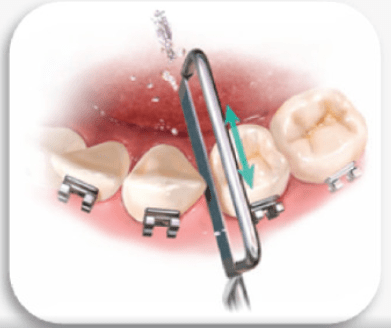
- Manually, with polishing strips that are passed between the teeth as if they were dental floss but thicker. With this technique the IPR we get is a minimum of 1-3mm.
- With a rotary method, that is, with a handpiece with a long, thin bur or with the stripping contra-angle, which they’ll pass between the teeth to file them little by little. In this case we can get a bigger gap between the teeth than with the manual technique.
Afterwards, we always recommend that our patients, as throughout the whole orthodontic treatment, use a fluoride rinse to remineralise the enamel and protect it, even more so if we’ve carried out dental stripping.
This will interest you > Invisible Orthodontics: The danger of “buying health” online.
Does carrying out dental stripping have disadvantages for patients?
IPR carried out correctly shouldn’t cause any disadvantage to our teeth, but it must be done correctly.
It isn’t the first time that patients come to us with cavities between the teeth because an incorrect IPR has been carried out, damaging more enamel than necessary, or patients with gaps between the teeth from an excess of dental stripping during their orthodontic treatment.
Other possible doubts about dental stripping:
Do you want to know whether dental stripping hurts?
Dental stripping is a minimally invasive technique that shouldn’t hurt. It’s carried out on the layer of the tooth called the enamel, which doesn’t have nerve endings, so it shouldn’t cause pain. That’s why it isn’t necessary to apply anaesthetic before doing it.
Are there other techniques besides dental stripping?
The goal of dental IPR is to gain more space in the arch. There are other alternatives, as we mentioned at the beginning, such as the extraction of teeth as part of the orthodontic treatment to gain space if we have a lot of crowding, for example:
- Another option would be to carry out an expansion of the dental arch, especially the upper one, where we can widen the maxilla and thereby gain more space to be able to align our teeth. This option would only be in cases where there’s little lack of space.
How many times can stripping be done?
Dental stripping or IPR can be done when and as many times as our orthodontist has planned during our treatment of invisible orthodontics or with braces.
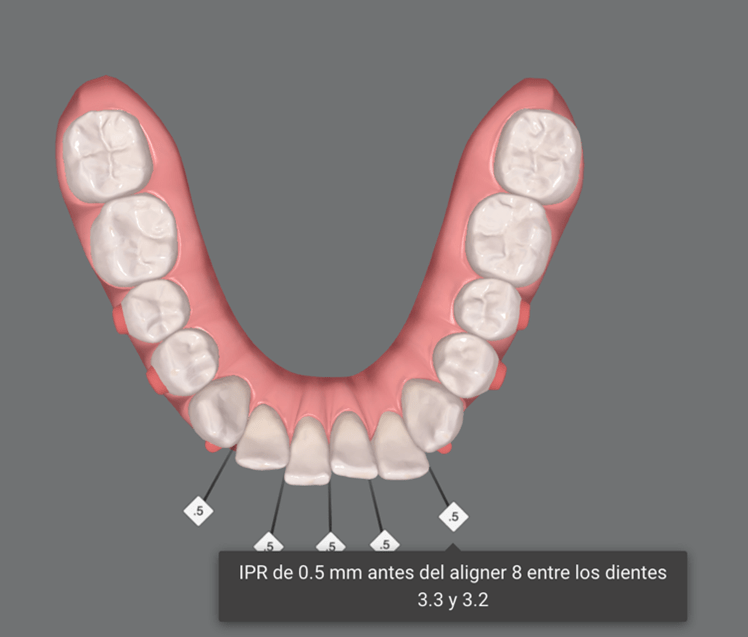
As we’ve explained above, if IPR is to be carried out in our invisible orthodontic treatment (Invisalign or Spark), the filing of the teeth will be planned in quantity, that is, our doctor will carry out the necessary millimetres of IPR between the teeth and the aligner we’ve planned (as we can see in the photograph where it tells us that we have to do 0.5mm of IPR between teeth 3.2 and 3.3 before aligner 8). Once it’s done, we’ll have to measure it to confirm that we’ve done the exact amount.
However, in treatments with fixed brace appliances we can do the filing of the teeth more progressively and little by little throughout the treatment at some visits that our orthodontist will indicate to us.
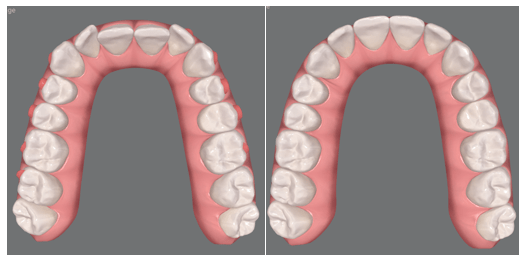
Dental stripping before and after:
Dental stripping is a very common procedure during orthodontic treatments, although it isn’t always necessary. Here we see a case where, having mild crowding, it was only necessary to file the teeth very little to be able to align them. That’s why it’s essential that our orthodontist is the one who plans your orthodontic treatment through a good initial diagnosis and advises you on the most suitable treatment for your case.
Don’t hesitate to call us if you have any doubt or if you’re encouraged to start your orthodontic treatment now! At Clínica Dental Doctores Tarazona: We Love Looking After Your Smile!