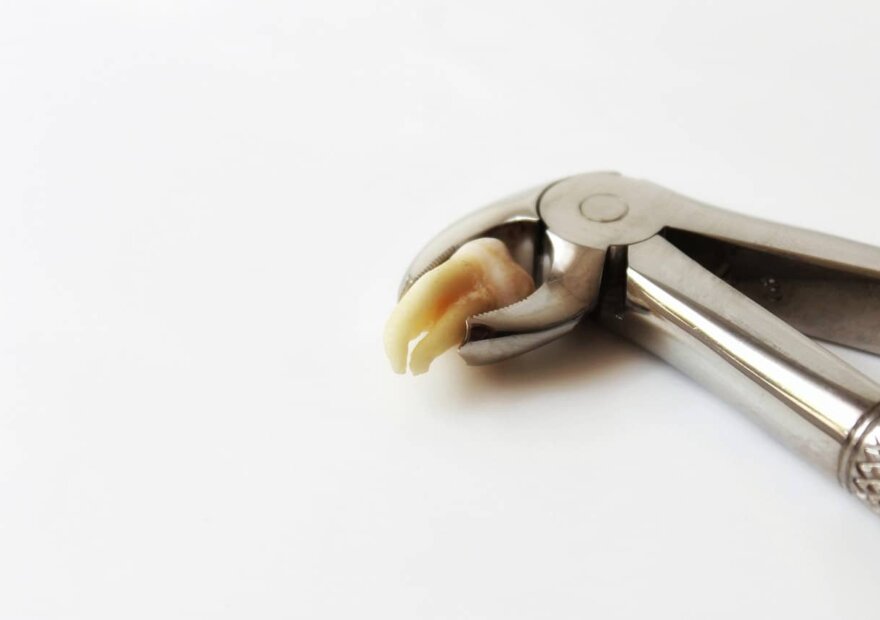

Wisdom Teeth
What are wisdom teeth? How many wisdom teeth do we have?
They’re the so-called third molars or wisdom teeth, which erupt at the back of the mouth, both above and below. That is, in total we have four wisdom teeth, in addition to the 28 teeth that make up the permanent set.
At what age do the third molars come through?
Normally, the wisdom teeth usually emerge at a stage of certain maturity, between 18 and 25 years old, although there are exceptions in which they may not come through.
Wisdom tooth extraction: When is it necessary?
There are cases in which the wisdom teeth come through without any problem, aligned and with enough space.
However, there are people who suffer certain complications in the eruption of these teeth, such as coming out at an angle, not having space to erupt, which complicates dental hygiene, generating a build-up of plaque and the formation of cavities. So, given this situation, the advisable thing is the extraction of these teeth.
How long do wisdom teeth take to come through?
It’s a process that can vary in each person, possibly lasting several years until they come through completely. Depending on each case, it can last several years until they come through completely. However, in general terms, they usually erupt between 17 and 24 years old, depending on each person.
Wisdom tooth pain?
Wisdom tooth pain can come accompanied by earache, headache, jaw pain or even sore throat.
The best way to relieve wisdom tooth pain is to go to your trusted professional so that they can study your case and advise you on the most recommended guidelines for you.
Infected wisdom teeth
The appearance of the infection can also cause earache and/or sore throat, so it can lead to confusion about its diagnosis. That’s why, when pain appears in the teeth or redness or inflammation, it’s important to go to the specialist. By taking an X-ray it’s possible to know whether or not the problem is in the wisdom teeth.
In the event that the diagnosis of an infection of the wisdom teeth is confirmed, it will be necessary to assess the state of the infection and of the tooth to assess whether treatment should be applied to keep it or whether, on the contrary, it’s more appropriate to extract it.
Whatever the case, it’s important to treat the infection in time to avoid the possible formation of abscesses that can complicate the problem with fever.
Symptoms of infected wisdom teeth
Some of these symptoms are the following:
- Bleeding in the gum
- Earache
- Pain when chewing
- Inflammation of the lymph nodes
- A swollen jaw
- Fever
- Sensitivity in the teeth to any temperature
- Bad breath
- A bitter taste in the mouth
Treatment of the wisdom teeth
As it’s a bacterial infection, even if it’s finally decided to extract the tooth, treatment with antibiotics is necessary.
It’s important to know that taking anti-inflammatory medications such as ibuprofen before going to the dental clinic can eliminate the pain and reduce the periodontal inflammation, hiding the problem of the infection.
- If the infection is due to a cavity, it may be possible to solve it with some fillings.
- If the bacteria reach the nerve it will be necessary to carry out a root canal. The root canal “kills the nerve” and solves the problem of the pain too. It’s normal to adjust the treatment with medications that help to control the infection.
- If the infection appears in the gums it will be necessary to carry out a periodontics treatment.
Can wisdom teeth move the teeth?
This is a belief that has persisted over time, but the truth is that there’s no scientific evidence to justify it.
There are several factors that favour the movement or crowding of the teeth, such as:
- Genetics: The size of the teeth, the maxillofacial development, the length and width of the jaw, etc. are important characteristics that condition it.
- Jaw growth: The jaw keeps growing during adulthood, so it can cause the teeth to move and crowd.
- Changes in the connective tissue: The fact that bone loss occurs due to periodontal disease can favour the movement of the teeth.
- Supernumerary teeth: They generate a lack of space through which they can cause crowding.
So, scientifically we can’t affirm one hundred per cent that the wisdom teeth are the ones that generate that crowding or dental movement.
How to soothe wisdom tooth pain?
3 tips for wisdom tooth pain:
- Apply heat or cold (whichever feels best to you) to the area of the cheek where the wisdom tooth is inflamed to soothe the pain and reduce the swelling.
- Rinses of warm (lukewarm) water with salt.
- Carry out a thorough oral cleaning.
How is the extraction of the wisdom teeth carried out?:
- An incision is made in the gum tissue so that the tooth and the bone are exposed.
- The bone that blocks access to the root of the tooth is removed.
- The tooth is divided into sections if it’s easier to extract it in parts.
- The tooth is extracted.